Project 7: The Glass Mosque

The Glass Mosque is an interdisciplinary book project conceived around a collective rethinking of the mosque through spatial, material, literary, and musical pathways. The phrase was coined by visual artist Shahzia Sikander.

Rather than treating the mosque as a religious symbol or architectural form, the book explores it as a word—mutable, charged, and open. Here, the mosque becomes a proxy for the commons, not in an imperialistic or universalizing sense, but as a site of shared attention, instability, and possibility. It is a term refracted through diasporic poetics, performance, geometry, and sound.

The Glass Mosque gathers the work of artists, theorists, composers, and architects. Composer and performer Vijay Iyer writes through the properties of glass to frame glass as a metaphor for understanding the spatial concept held by the phrase The Glass Mosque. Fred Moten responds with a refusal of fixed meaning through literature and music. Bhanu Kapil & Blue Pieta contribute a performance score that renders presence and loss in parallel. Alexander Schweder contributes a work of fiction. As well as works written by artists, The Glass Mosque heavily features works by authors and scholars such as architect Aki Ishida, Queer theorist Alpesh Kantilal Patel, art historian Kishwar Rizvi and her daughter Yasmin Bergemann, and comparative literature scholar Na’ama Rokem. Central to the book are yet unpublished drawings from the archive of Shahzia Sikander.

The book is a softcover volume, portable by design. It functions as a field of encounter, shaped by overlapping forms of inquiry into the intersections of art and theory, architecture and diaspora, sound and space. It is for artists and educators, as well as those curious about how aesthetic practices might unsettle, question, and reimagine the world around them.

The Glass Mosque book and this gathering have been made possible by significant support from the MacArthur Foundation X-Grant, and the generosity of The Community of Literary Magazines and Presses, and the Minerva Projects’s board.

Yasmin Zainab Bergemann is an architectural designer and organizer from New Haven, Connecticut. She received her B.S. in Ecology and Evolutionary Biology from Yale University in 2024 and is based in Brooklyn, New York. Her practice and passions coalesce around systemic environmental justice and creating spaces that build and enact community strength.

Aki Ishida is Professor and Director in the College of Architecture at Washington University in St. Louis. Her work centers on aspects of architecture that are temporal and mutable. She is the author of Blurred Transparencies in Contemporary Glass Architecture, which examines glass in broader cultural and social contexts.

Vijay Iyer is a composer and pianist in New York. In 2025 he released Defiant Life with Wadada Leo Smith and Thereupon with the group Fieldwork. Rolling Stone once declared that “Iyer’s music knows no bounds.” He has received a MacArthur Fellowship, a Doris Duke Artist Award, and three Grammy nominations. He teaches at Harvard University.

Fred Moten teaches in the Department of Performance Studies at New York University. His most recent work, in collaboration with Brandon López, is Revision (TAO Forms Records, 2025).

Alpesh Kantilal Patel is Associate Professor of Art History at Temple University. His book Multiple and One: Writing Queer Global Art Histories is forthcoming in 2027. He organized a trilogy of exhibitions in 2023 at UrbanGlass, New York City, under the theme Forever Becoming: Decolonization, Materiality, and Trans Subjectivity*.

Bhanu Kapil is a British American writer, currently based in Cambridge as an Extraordinary Fellow of Churchill College. She is also a Fellow of the Royal Society of Literature and the recipient of a Windham-Campbell Prize. Her newest book, Autobiography of a Performance, was written with Blue Pieta (the87press, 2025).

Blue Pieta is a UK-based artist, director, performer, and dramaturg. They were dramaturg for Thikra: Night of Remembering (2025), choreographed by Akram Khan. They co-authored Autobiography of a Performance (the87press, 2025) with Bhanu Kapil. Their work has been curated by Serpentine Galleries, Courtauld Gallery, The Place, and Royal Court Theatre.

Sara Reisman’s most recent exhibition, Past as Prologue: A Historical Acknowledgment (2024–25), examined the role of art in U.S. nation-building through the lens of the National Academy of Design’s collection. Recent interviews with Dor Guez and Hock E Aye Vi Edgar Heap of Birds have been published in BOMB Magazine. She teaches art history in the School of Visual Arts’ M.A. program in Curatorial Practice.

Kishwar Rizvi is an architect and art historian focusing on early modern Iran and contemporary West and South Asia. Her publications include The Transnational Mosque: Architecture and Historical Memory in the Contemporary Middle East (2015). Her current research involves histories of mobility, subjecthood, and empire. She teaches at Yale University.

Na’ama Rokem teaches Hebrew and Comparative Literature at the University of Chicago. Her book Zionism in Translation: Encounters in the German-Hebrew Archive (University of Chicago Press, forthcoming fall 2026) tracks a series of ambivalent conversations that cross between languages and ideological positions, with chapters on Hannah Arendt, Paul Celan, and others.

Alex Schweder’s works of “performance architecture” have been collected and exhibited at museums including the Museum of Modern Art (MoMA), San Francisco Museum of Modern Art (SFMOMA), Tate Britain, and the Tel Aviv Museum of Art. Schweder is an American Academy in Rome fellow, holds a doctorate in architecture from the University of Cambridge, and a master’s degree in architecture from Princeton University.

Shahzia Sikander is widely celebrated for subverting Central and South Asian miniature painting traditions into dialogue with contemporary international art practices and for launching the form known today as neo-miniature. Sikander is a recipient of the MacArthur Fellowship and the Pollock-Krasner Foundation’s Pollock Prize for Creativity, among other honors.

Date: August 15, 2022
Share: Facebook, Twitter, Google Plus
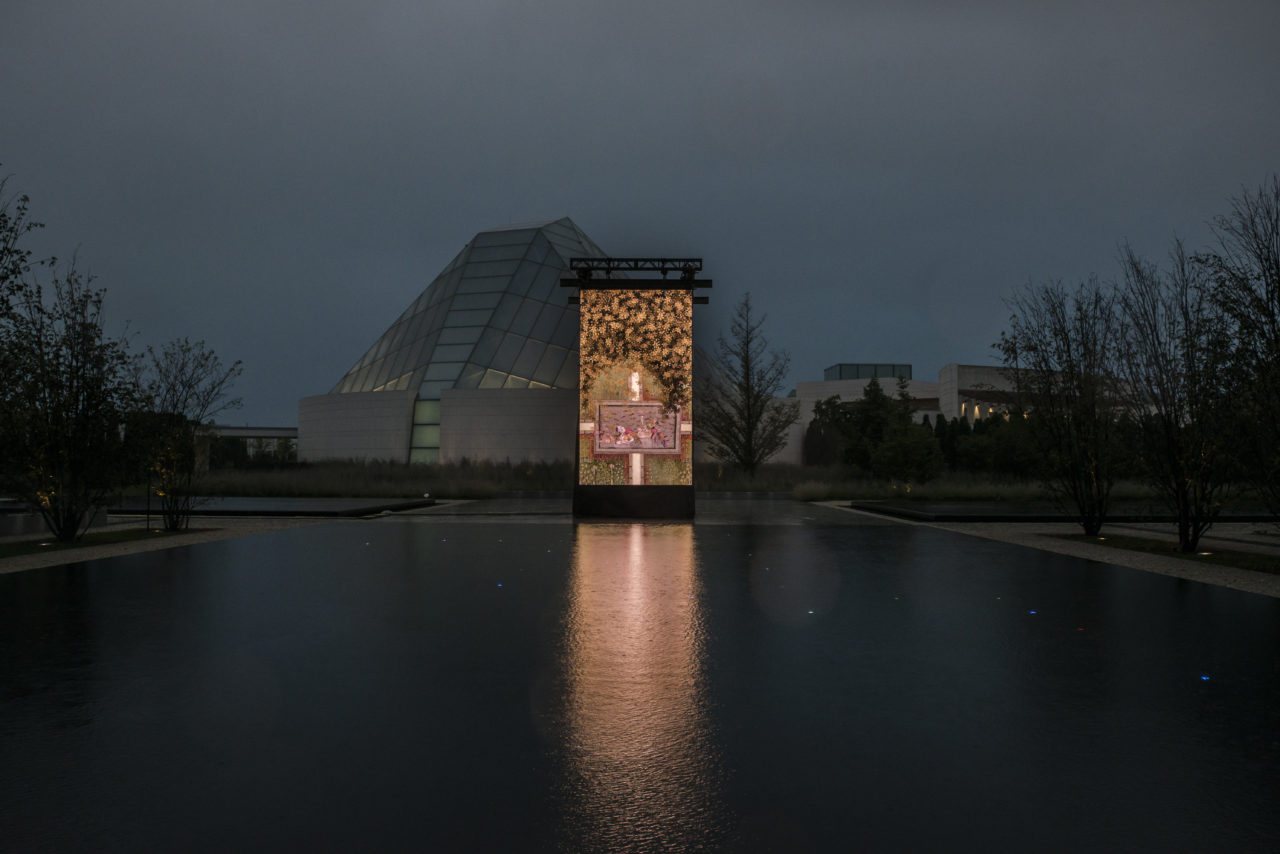
Disruption as Rapture Aga Khan Museum. Nuit Blanche Festival. 2017. Toronto.